


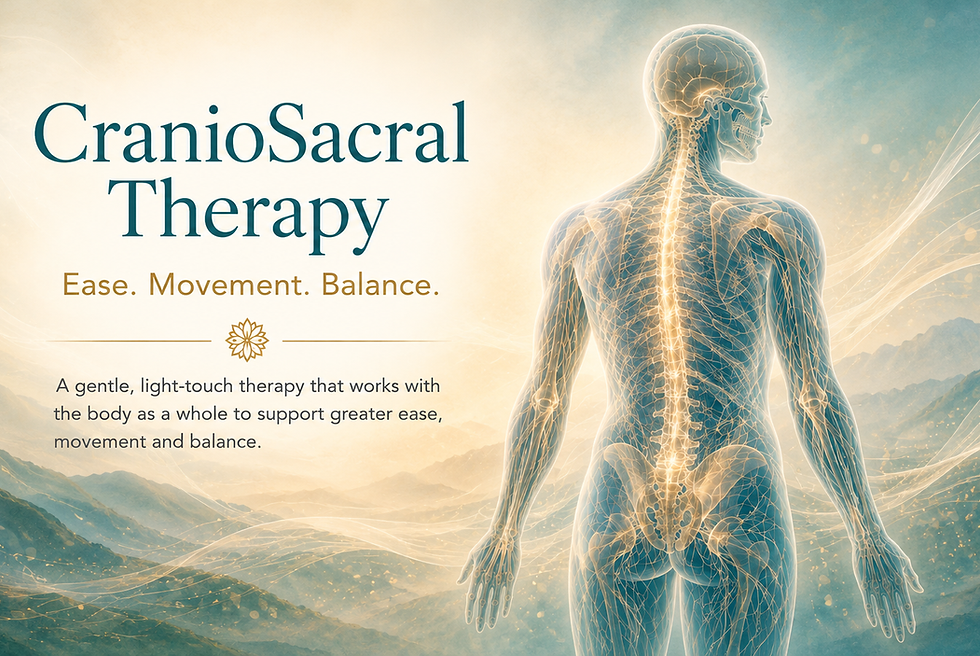
What is CranioSacral Therapy?
CranioSacral Therapy (CST) is a gentle, hands-on therapy that works with the body as a whole.
Using very light touch, the practitioner works with the craniosacral system and the tissues and structures throughout the body, including the skull, spine and sacrum.
Although the name CranioSacral naturally makes people think of the head, a session is not limited to the head or skull. The body is interconnected, and restrictions or tension in one area can influence how other areas move and function.
CST takes a whole-body approach, looking beyond the area where you are experiencing discomfort to explore what else may be contributing to the pattern.
People often come to CranioSacral Therapy because something in their body simply isn't settling.
They may have persistent neck or back pain, headaches, jaw problems, restricted movement or an old injury that continues to cause problems — sometimes after already trying a number of other avenues.
Others come because their body feels as though it is carrying the effects of prolonged stress or trauma, and they are looking for a gentle, body-based way of supporting greater ease and regulation.
Neck, Back & Structural Discomfort
Headaches, Migraines, Jaw & TMJ
Movement & Old Injuries
Stress, Trauma & Nervous System Regulation
Why do people choose CranioSacral Therapy?
Persistent pain, stiffness or restriction that doesn't seem to be resolving.
Headaches, migraines, tension around the head and neck, jaw discomfort or problems following dental work.
Restricted movement, lingering problems after an injury, or noticing that one side of the body doesn't move or feel quite like the other.
When prolonged stress or traumatic experiences seem to be held not only emotionally, but physically as well.
What happens during a CranioSacral Therapy session?

If this is your first CranioSacral Therapy appointment at De-Stress and be HAPPY, we'll begin by talking about what has brought you in, what you have been experiencing and how it is affecting your everyday life.
Before beginning the hands-on work, we'll usually establish a few simple starting points based on what has brought you in. This might involve a particular movement, noticing where you feel restriction or discomfort, or rating what you are experiencing out of ten. This gives us something meaningful to compare again later.
You'll remain fully clothed and lie comfortably on the treatment table. CranioSacral Therapy uses a very light touch, with hands placed at different areas of the body depending on what is being assessed and worked with. This may include the head, neck, spine, ribcage, sacrum, hips, legs or feet.
During the session, some people notice warmth, subtle movement, bubbling or other sensations within the body. Others simply notice themselves becoming deeply relaxed. Your experience may be different from someone else's, and you don't need to feel anything in particular for the session to be worthwhile.
Towards the end of the appointment, we may revisit some of the movements or sensations you noticed at the beginning, giving you an opportunity to notice whether anything feels different.

Kerry Heritage
CranioSacral Practitioner
Meet your CranioSacral Therapy practitioner
Kerry has undertaken CranioSacral Therapy training through the Upledger Institute, including CranioSacral Therapy 1 & 2, SomatoEmotional Release 1 and The Brain Speaks 1.
Her approach is practical and individualised, with each session guided by what has brought you in and what your body is presenting on the day.
After your CranioSacral Therapy session
After a CranioSacral Therapy session, some people notice a difference straight away, while for others the changes are more gradual.
You may notice changes in movement, comfort or how your body feels over the following days. Sometimes these changes become more apparent as you go about your normal activities — something that had been difficult may feel easier, or you may simply realise that you haven't been noticing the same discomfort.
This is one of the reasons we spend some time at the beginning of your appointment understanding what you are experiencing and how it is affecting you. It gives us something meaningful to refer back to as you notice what changes.
"Kerry is fabulous - caring, kind, compassionate, knowledgeable and is making a huge difference in not only my sons life but our whole family."
- Amanda & Son - West Beach SA -
I was so relieved when I found Kerry. She has helped me so much over the years dealing with stress and my tinnitus through CST. She is dedicated, kind and truly cares about her clients and I never feel like I’m just a number to her. Her practice is warm, calm and inviting especially with her little dog and instant smile maker when you arrive.
- Holly - Canberra ACT -
When there may be more to the story
SomatoEmotional Release (SER)
CranioSacral Therapy is primarily a hands-on therapy, but sometimes a session can bring more than physical responses to the surface. A change in breathing, a deep sigh, tears, an unexpected movement, emotion or memory may arise as the work progresses.
When this happens, your practitioner continues to work with the craniosacral rhythm and the physical responses occurring within the body. Dialogue may also become part of the session, with what you are noticing, remembering or feeling helping to guide the work — and changes within the body helping to guide the conversation.
At other times, the conversation may naturally slow or stop while something is changing physically. Your practitioner continues to follow the body's responses, allowing time for that process before moving on.
This interaction between physical responses, awareness and dialogue forms part of SomatoEmotional Release (SER), an extension of CranioSacral Therapy. Kerry's counselling training also provides additional skills for supporting the conversations that can sometimes arise during this work.
If something significant emerges during a CranioSacral Therapy session and would benefit from more time and attention, a separate SER appointment may be discussed.
Supporting greater ease, movement and balance.
CranioSacral Therapy takes a gentle, whole-body approach, with each session guided by what has brought you in and what your body is presenting on the day.
CranioSacral Therapy
55 minute appointment
Face-to-face $150
29 Jetty Road
Brighton, South Australia 5048

REAL UNDERSTANDING PRACTICAL TOOLS LASTING CHANGE

